
When a Look Becomes a Story
The entire conflict started over two people interpreting a glance through the lens of insecurity, assumption, and pride.
FAITH & FAMILY
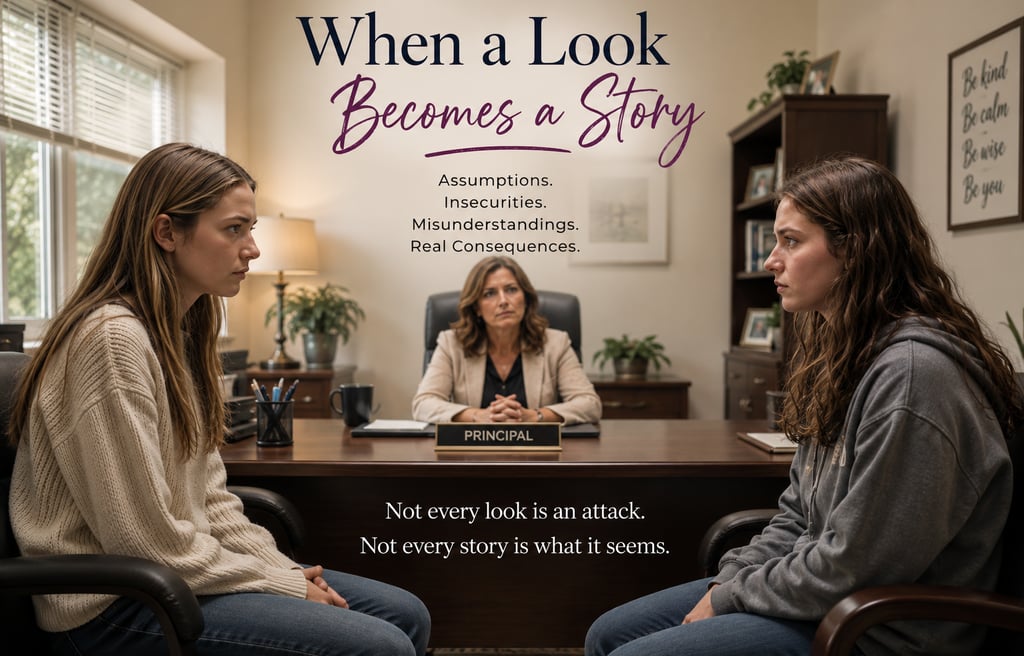

Working in education taught me many things, but one lesson shows up again and again: people often respond more to what they believe they see than to what is actually happening.
Years ago, while serving as a high school principal, I had to break up a fight between two students. By the time we separated them, emotions were high, voices were louder than necessary, and both girls were convinced they had been wronged.
As always, I brought them into the office one at a time to hear each side of the story.
The first student explained confidently, “It started in the library. She kept looking at me. So I started looking at her because she can’t just be looking at me. Then in the hallway she looked at me again. After class, there she was again looking at me. So I just threw it down.”
Then I called in the second student.
Surely, I thought, I would hear a completely different explanation.
I did not.
“She was looking at me,” the second girl said. “You know how people do. She can’t just be looking at me.”
That was it.
The entire conflict started over two people interpreting a glance through the lens of insecurity, assumption, and pride.
Thankfully, we had an excellent counselor on campus who worked with both girls on communication, emotional regulation, and conflict resolution. Over time, they began to understand an important truth:
Not every look is an attack.
Not every silence is rejection.
Not every moment requires a battle
Honestly, that lesson is not just for teenagers. As adults, we still do this all the time.
Someone does not speak, and we assume they are upset with us.
Someone looks serious, and we decide they dislike us.
Someone does not respond quickly, and suddenly our minds create a story that may not even be true.
Many conflicts begin not with facts, but with interpretation.
Scripture reminds us how important it is to guard our thoughts and assumptions: “Everyone should be quick to listen, slow to speak and slow to become angry.” — James 1:19
Wisdom pauses before reacting.
Maturity asks questions before making accusations.
And confidence no longer needs to fight every perceived offense.
I think about those two girls sometimes because their argument revealed something deeper: both of them were carrying a level of insecurity that caused them to see threat where there may have been none at all.
The truth is, how we see ourselves often shapes how we interpret everyone else.
When we are grounded, emotionally healthy, and secure in who God created us to be, we stop treating every glance, comment, or disagreement like a personal attack.
Sometimes people are simply… looking around the room.
And sometimes the peace we are praying for begins when we stop assuming the worst about one another.